Which cycle size is actually right for my child?
The quickest answer is to check your child’s height first, age second, and inseam for a more accurate fit.
Age is useful as a starting point, but two children who are both 7 years old can have completely different heights and leg lengths. They may not feel comfortable on the same bicycle.
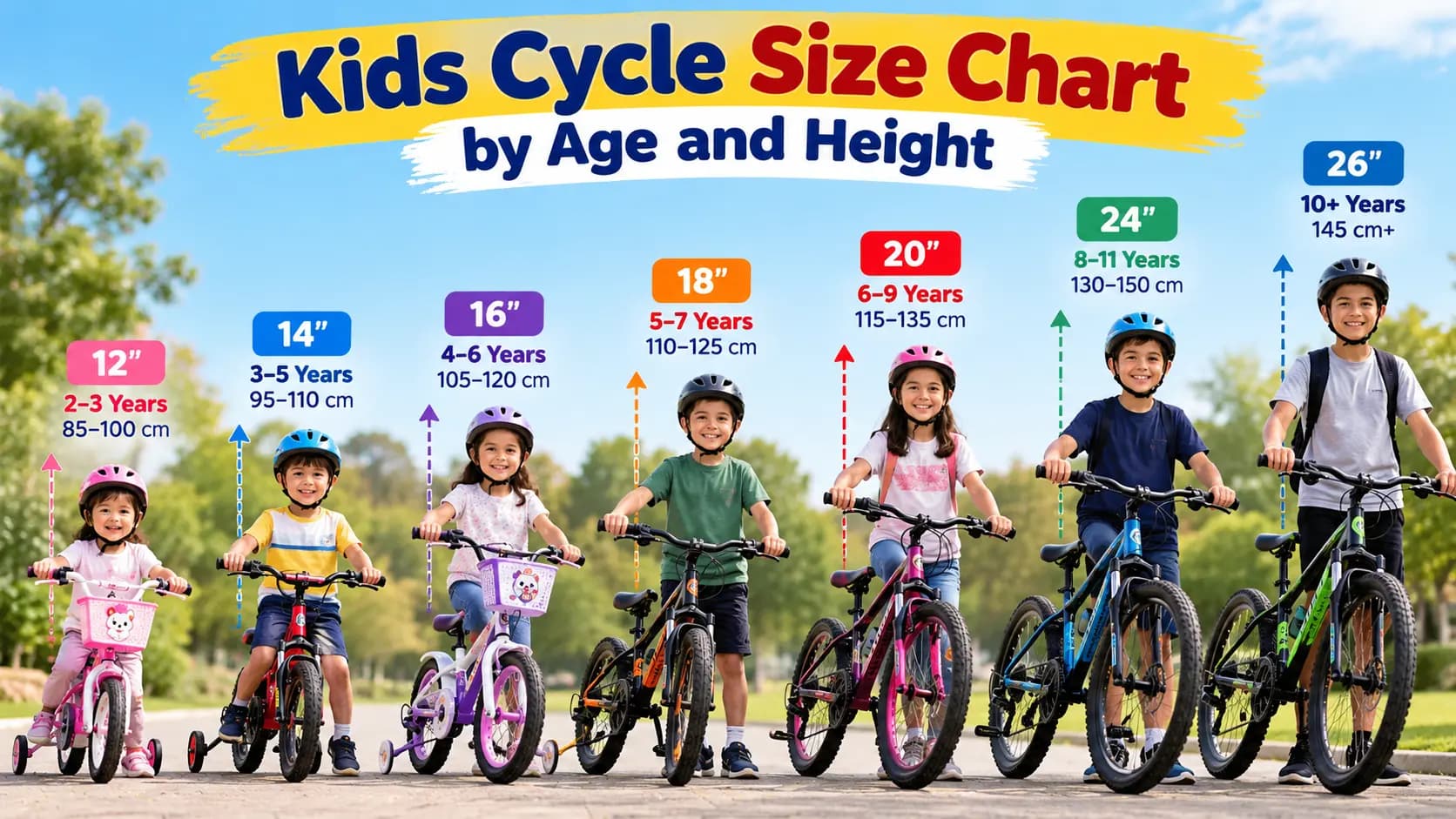
That is why this kids' cycle size chart combines age, height and wheel size to help parents make a better choice.
Kids Cycle Size Chart by Age & Height
Age | Approx. Height | Common Wheel Size | Suitable For |
2–3 years | 85–100 cm | 12 inch | Balance bikes and first-time riders |
3–5 years | 95–110 cm | 14 inch | Beginners and young riders |
4–6 years | 105–120 cm | 16 inch | Children learning independent riding |
5–7 years | 110–125 cm | 18 inch | Children between 16T and 20T sizes |
5–9 years | 115–135 cm | 20 inch | Independent riders and everyday cycling |
7–11 years | 125–150 cm | 24 inch | Taller kids and longer rides |
10+ years | 145 cm+ | 26 inch | Older children and teenagers |
Quick answer: A 14-inch cycle commonly works for younger children around 3–5 years, 16-inch for around 4–6 years, 20-inch for around 5–9 years and 24-inch for taller children around 7–11 years. But always confirm the size using your child’s current height and bike fit.
These ranges overlap because children grow differently, and two bicycles with the same wheel size can still have different frame dimensions.
What Does 14T, 16T, 20T or 24T Mean?
If you are shopping online in India, you will regularly see cycle names containing terms such as 14T, 16T, 20T and 24T.
The number mainly refers to the wheel size in inches.
For example:
14T means a cycle with approximately 14-inch wheels.
16T means approximately 16-inch wheels.
20T means approximately 20-inch wheels.
24T means approximately 24-inch wheels.
But wheel size alone does not guarantee that every cycle will fit exactly the same way. Frame design, seat height, handlebar position, and overall bicycle geometry can change the way a bike feels to a child.
So use wheel size to shortlist the cycle, not as the only measurement.
Why You Should Not Choose a Kids Cycle Only by Age
Parents often search for questions like:
“What cycle is suitable for a 5-year-old?”
“Which cycle size is best for a 7-year-old?”
“Can my 9-year-old ride a 24-inch cycle?”
These are completely reasonable questions, but age cannot give the full answer.
Imagine two children who are both 6 years old.
One is 108 cm tall while the other is 122 cm tall. The shorter child may feel comfortable on a 16-inch bike, while the taller child may already be comfortable on a 20-inch model.
This is why height is generally more useful than age when choosing a kids' cycle.
If your child is between sizes, their inseam and riding experience become even more important.
How to Measure Your Child Before Buying a Cycle
You do not need any special equipment. A measuring tape and a book are enough.
First, ask your child to stand straight against a wall without shoes. Measure from the floor to the top of the head. This gives you their current height.
Next, measure the inseam.
Ask your child to stand with their feet slightly apart. Place a hardcover book between their legs, similar to where a cycle seat would sit. Measure from the floor to the top of the book.
That measurement gives you an approximate inside leg or inseam length.
Why does this matter?
Because your child needs enough control to comfortably get on the bike, start riding, stop, and put their feet down when required.
How to Know If the Cycle Actually Fits
Even after checking a kid's cycle size chart, a physical fit check is useful.
When your child sits on the bicycle, check whether they can comfortably reach the handlebars without stretching their body too far forward.
Their knees should not feel cramped while pedalling.
They should also be able to control the brakes comfortably if the bicycle uses hand brakes.
For beginners, being able to put their feet down easily can make starting and stopping much less stressful.
An experienced child who already rides independently may be comfortable with a slightly higher saddle position than someone learning for the first time.
The goal is simple: your child should control the cycle instead of struggling to control it.
Which Cycle Size Is Best for a 3 to 5-Year-Old?
Children around 3 to 5 years old commonly start around the 12-inch to 14-inch range, depending on their height.
For a child moving from a small balance bike or starting with pedals, 14T can be worth considering if their height matches the bicycle.
Parents comparing this size can look at a model such as the 14T Whizzy IC Kids Cycle while checking whether its dimensions suit their child.
At this stage, easy handling matters more than buying the biggest possible cycle.
A bicycle that feels manageable can help a beginner build confidence faster.
What Cycle Size Is Suitable for a 4 to 6-Year-Old?
For many children between 4 and 6 years old, 16-inch cycles are a common option.
However, this age group has a lot of variation in height.
A smaller child might still be more comfortable on a 14T, while a taller 6-year-old may be moving towards an 18T or even certain 20T models.
A 16-inch option from the Golden Cycles range is the 16T Forester IC Kids Cycle.
Before choosing, compare the child's height and leg length rather than buying simply because the product says “16T.”
What Cycle Size Is Best for a 6 to 9-Year-Old?
This is where 20-inch cycles become very common.
A 20T cycle can work well for many children who already know how to balance and pedal independently. Depending on the bicycle, this size may also introduce children to more grown-up cycle features.
If you are comparing options in this range, you can check the 20T Forester Kids Cycle.
Again, “20 inch” describes the wheel category. It does not mean every 20-inch model has exactly the same seat height or riding position.
For a child near the lower end of the recommended height range, make sure they are not stretching to reach the pedals, handlebars or ground.
When Should a Child Move to a 24-Inch Cycle?
A 24-inch cycle is generally aimed at taller kids who have outgrown smaller 20-inch bicycles.
For many children, this transition happens somewhere around the 7 to 11-year age range, but height is more useful than age alone.
You can compare a model such as the Kross Spider 24T Kids Bicycle when looking at options in this wheel-size category.
At this stage, also consider how your child rides.
A child cycling mainly inside a housing society may have different needs from someone riding longer distances, using uneven roads or going on weekend rides with family.
When Can a Child Use a 26-Inch Cycle?
Once children become taller, usually around 145 cm or above, certain 26-inch cycles may start becoming suitable.
This is also the point where the difference between a kids' bicycle and a smaller adult-style bicycle starts becoming less clear.
For older or taller riders, a model such as the Hero Rove 26T can be considered based on the rider's height and actual fit.
Do not move your child to 26T simply because they have reached a certain birthday.
Check whether they can comfortably mount the bicycle, control it, brake properly, and maintain a comfortable riding position.
What If Your Child Is Between Two Cycle Sizes?
This is one of the most common problems parents face.
Suppose your child’s height falls near the top of the 16-inch range and the bottom of the 20-inch range. Should you buy 16T or 20T?
Start with riding ability.
For a beginner who is still developing balance and confidence, the smaller suitable bicycle will usually feel easier to control.
For an experienced rider who comfortably starts, turns and brakes independently, the larger option may sometimes work if the bike fits properly.
Do not choose a much larger cycle only because “the child will grow into it.”
You may save yourself from buying another bicycle sooner, but the child has to ride an oversized cycle today.
Comfort and control should come first.
Should Beginners Use Training Wheels?
Training wheels, also called stabilisers, can help some young children become familiar with pedalling and steering.
However, training wheels should not be used to compensate for buying a bicycle that is too large.
A correctly sized bike is still important.
Some children start with balance bikes and move directly to pedal cycles without stabilisers. Others feel more comfortable using training wheels for a period.
There is no single timeline that suits every child.
The child's confidence and ability matter more than comparing their progress with other children of the same age.
Does Your Child Need Gears?
For small kids learning basic cycling, gears are usually not the first thing parents need to focus on.
Comfortable sizing, manageable weight, brakes, and easy handling matter more.
As children become older and start riding longer distances or on slopes, geared cycles may become more useful.
Before paying extra for more features, ask yourself where your child will actually ride.
For short evening rides around the society or nearby park, a simple cycle may be enough.
For longer rides or changing road conditions, different features may become more useful.
5 Things Parents Should Check Before Buying a Kids Cycle
Measure height and inseam: Do this before looking at wheel size.
Shortlist the wheel size: Use age only as additional guidance.
Check the child's riding experience: Beginners and confident riders may fit the same bicycle differently.
Check control: Your child should comfortably reach the handlebars, pedals and brakes.
Test the cycle when possible: Two bikes labelled 20T can still feel different because of their frame and seat position.
This simple process is more reliable than choosing a cycle based only on your child’s birthday.
Common Mistakes Parents Make When Choosing Kids Cycle Size
One of the biggest mistakes is buying a cycle that is intentionally too large.
Parents naturally want a bicycle to last several years, but a cycle that is difficult to control today may reduce the child’s confidence.
Another mistake is assuming all bicycles with the same wheel size are identical.
They are not.
A third mistake is comparing your child only with siblings or friends. Your neighbour's 7-year-old might comfortably ride a 24T while your 7-year-old feels much better on a 20T. Both can be completely normal.
The right cycle size is based on the rider, not just the age printed on a chart.
Final Tip: Choose the Cycle Your Child Can Ride Comfortably Today
A kids' cycle size chart makes shopping easier, but it should be the beginning of your decision, not the end.
Start with your child's height, confirm the inseam, shortlist the correct wheel size, and finally check how the child actually sits and rides on the bicycle.
Remember this simple rule:
Age helps you shortlist. Height improves the choice. Inseam and actual fit confirm it.
If you are still unsure whether your child needs a 14T, 16T, 20T, 24T or 26T cycle, compare the available options at Golden Toys & Cycles or visit the Golden Cycles store in Goregaon West, Mumbai with your child.
A cycle that fits correctly today will usually be easier to control, more comfortable to ride and a lot more fun for your child.